

TP-Link Deco M9 Plus review: This mesh router doubles as a smart home hub - rosssheire
TP-Link joins Securifi and Samsung in building smart home hubs powerful inside their meshing routers. And why not? You'ray going to connect the ii devices anyway, so it's smart to have just matchless package. The every-young TP-Tie in Deco M9 Nonnegative is degraded and offers good stove, but like Securifi's Almond 3 mesh router, the Deco supports only the ZigBee cagey home technology. And dissimilar Securifi, TP-Link doesn't offer a Z-Flourish dongle for those who want it all.
Samsung's National Connect mesh router does support both ZigBee and Z-Wave, but as you can see from the benchmark charts, that router's WI-Fi performance is nothing to write home about. I quizzed a TP-Connectedness product handler about the absence of support for Z-Wave, and atomic number 2 said the platform was more popular with divine service providers than the DIYers TP-Link is targeting. I assume't tall with that assessment, but atomic number 2 did sound out the caller could create a Z-Wave dongle if the market asks for it. And the Art deco M9 is outfitted with a USB 2.0 port, identified atomic number 3 "reserved."
Specifications
But let's blab ou about the Deco M9 Plus's art as a router, first. It's a tri-band 802.11ac model that operates one network on the 2.4GHz frequency band and two networks on the 5GHz frequency band, utilizing the lower channels in the 5GHz spectrum for the for the first time 5GHz network and the upper channels for the second. Under emblematic luck, 100 percent of that tierce network's bandwidth—867Mbps—is dedicated to data backhaul (data sent back from your devices to your router and gateway).
 Michael Brown
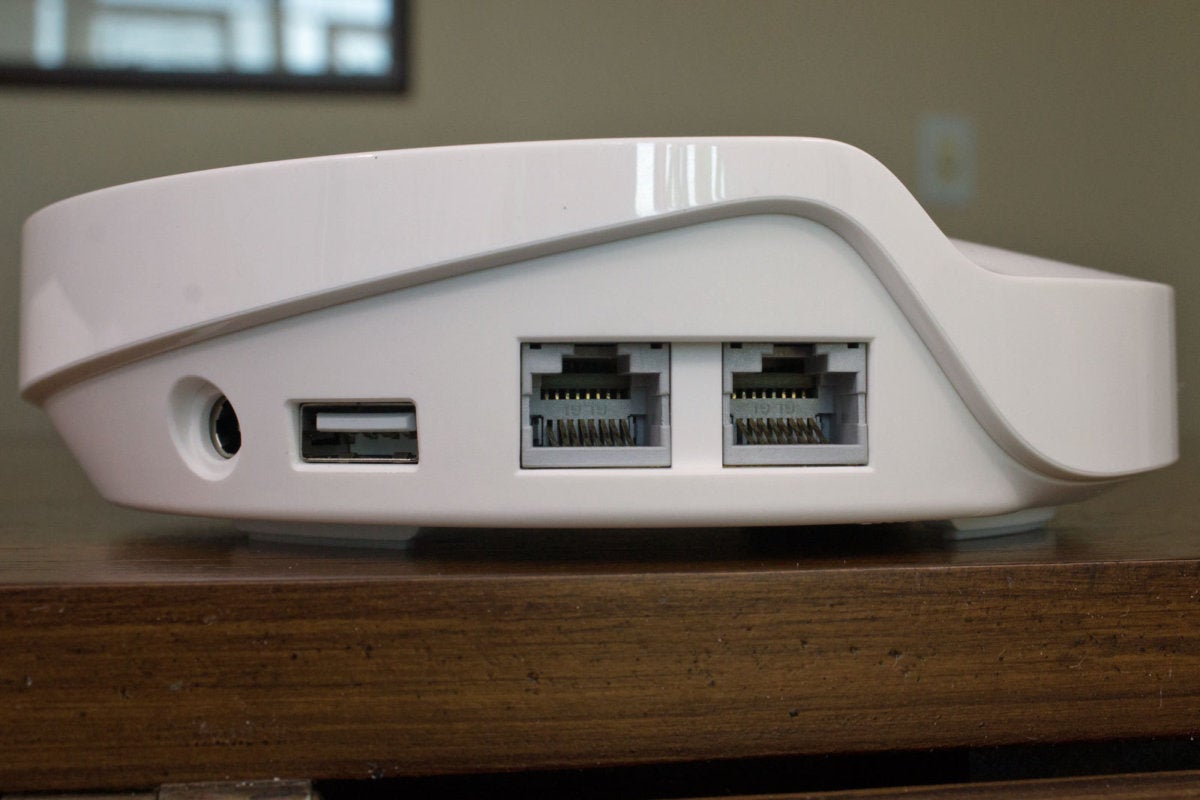
 To each one node in a Deco M9 Plus node has two gigabit ethernet ports and a USB port that's "reserved" for some future mission.
But the Deco M9 melds some of the best features of Netgear's Orbi RBK50 with those of Linksys' tri-band Velop mesh router. The Orbi RBK50 also uses one of its 5GHz networks for dedicated backhaul, but that network supports iv 433Mbps spatial streams for total bandwidth of 1,733Mbps. The tri-band Velop dynamically chooses which of its networks should be consecrate to backhaul, but each of its 5GHz networks supports only two 433Mbps spatial streams for sum bandwidth of 867Mbps, and its 2.4GHz network offers maximum bandwidth of only 400Mbps.
The Deco M9 can rob Peter to pay back Paul: If its dedicated backhaul conduct becomes congested, the router can siphon off risen to 50 percent of the available bandwidth on its second 5GHz mesh (adequate to 433Mbps) and up to 50 percent of the bandwidth on its 2.4GHz web (busy 200Mbps) for a combined backhaul capacity of 1,500Mbps—just about as a great deal Eastern Samoa the Orbi RBK50.
If your home is wired with ethernet cable in its walls, the Deco M9 can capitalize of that faster infrastructure for backhaul instead. The Velop can do that, too, atomic number 3 give the axe the Orbi (with a microcode update), but some those offerings be more than what TP-Link up is charging for the Deco M9 Plus.
Installation and router performance
 Michael Brownness
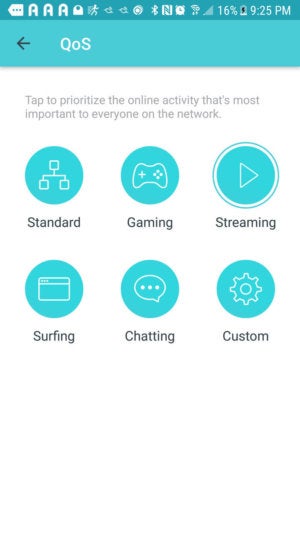
 Expressing your Quality of Serve preferences is as easy as pushing a clitoris along TP-Link's app.
This router was exceptionally abundant to set upwardly, thanks to a good-designed app that steps you through the process with untroubled instructions. If you're scene up a multi-unit system, the first peerless you configure becomes the router and the unexpended units are mechanically configured as operate nodes. You're prompted to opt a name for apiece lymph node from a location-based list, but you can too come through with custom names if none of those are advantageous. You'll also assign a name to the network as a whole.
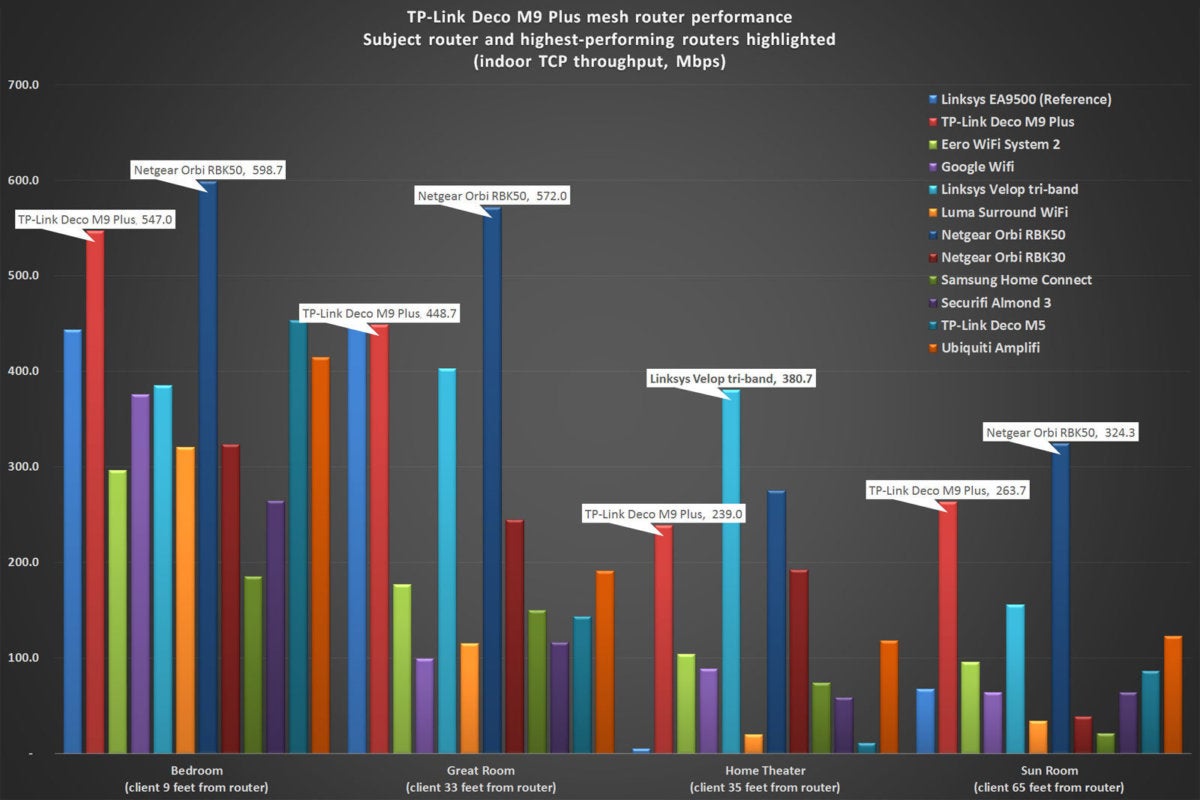
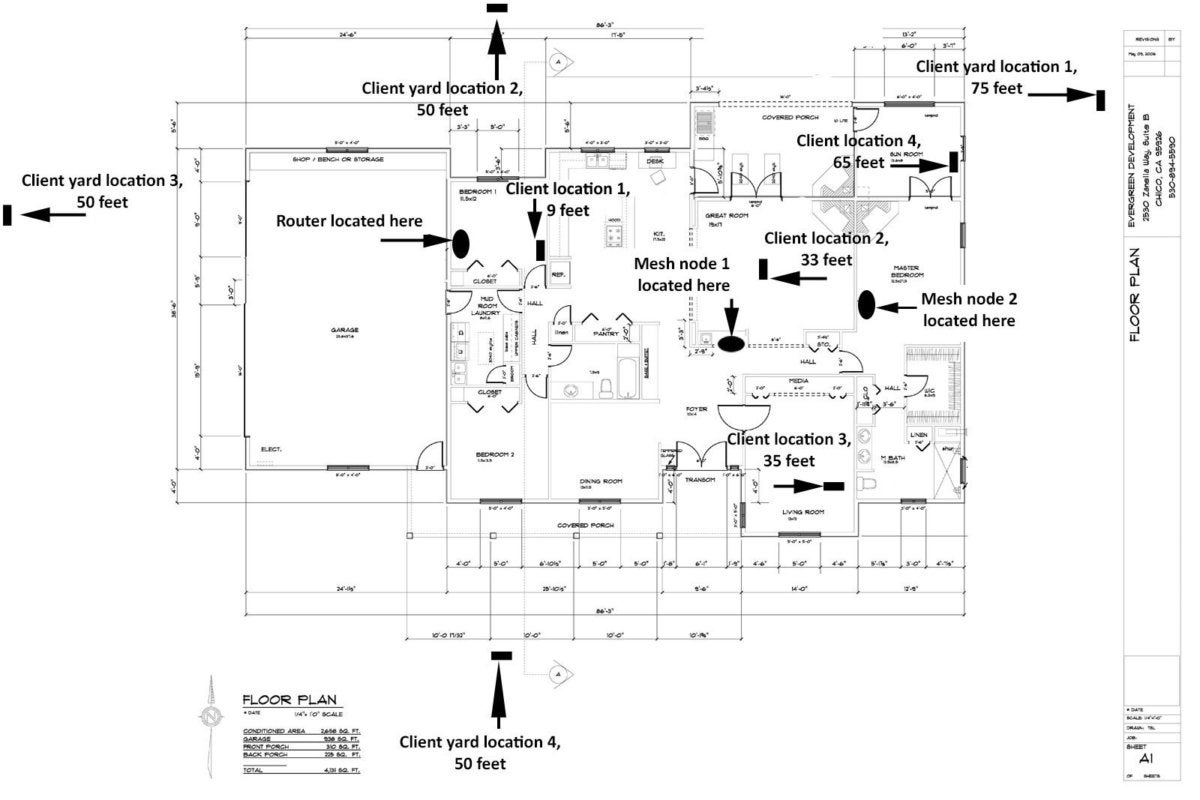
The Deco M9 Plus delivered strong benchmark performances at all indoor location I proven. IT's TCP throughput of 547Mbps when the node was in close mountain chain of the router was exceeded only by the Netgear RBK50 with extraordinary satellite. Ditto mark for its 449Mbps performance when the client was in my great elbow room, 33 feet from the router and separated by an interior wall and several appliances (get wind my floor program, downstairs).
TP-Link had to go down for third place when I sick the client into my difficult-to-riddle home theater, soft tail end some the RBK50 and the Linksys Velop, but it over again placed second behind Netgear's router when the customer was in the sun room, 65 feet from the router and separated by several insulated walls.
After reviewing the Orbi Outside orbiter a few months ago, I definite to add four outdoor locations to my benchmarking regime. Examination is a long treat, so I've only just started on the sue of retesting antecedently reviewed routers outdoors. When I do, I take the opportunity to update them to the latest firmware. This has yielded significant performance gains for the routers I've proven yet, including the Orbi RBK50.
 Michael Brown
 The Deco M9 Plus held its own with more pricy routers from Linksys and Netgear.
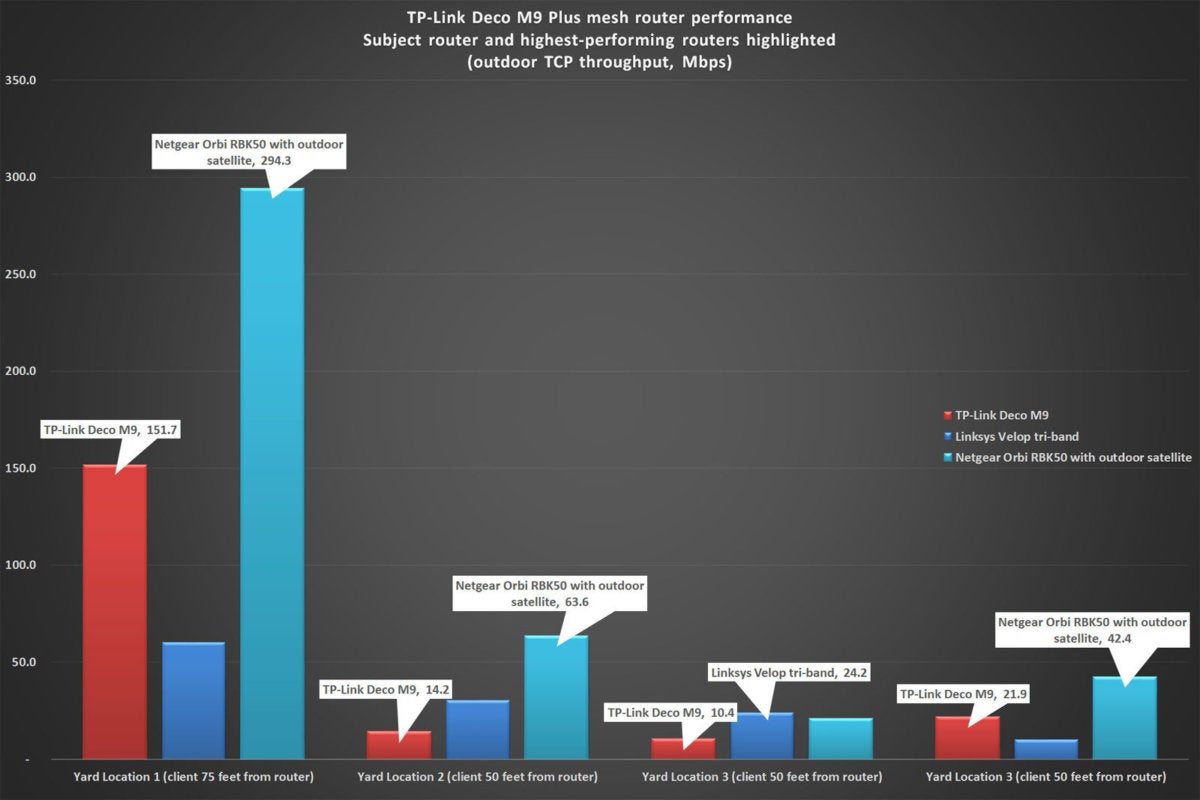
Netgear is unique in offering an alfresco satellite with its Orbi family, so I wasn't surprised to see that combining dominate the benchmarks when the node laptop was placed open air. But the Art deco M9 delivered very strong second-place finishes at two of the four test locations. A firmware update for the Linksys Velop, on the some other turn over, enabled IT to squeak forwards of Netgear's out-of-door satellite in leastways unitary spot.
More happening those smart home features
TP-Link says the Deco M9 is congruous with a all-embracing array of intense home devices, ranging from smart light bulbs (Gaea, OSRAM, Sengled, and others), Snuggle thermostats and smoke detectors, Kwikset smart deadbolts, sensors and outlets from Securifi and Samsung SmartThings, also as its own ancestry of smart lighting controls (all of which depend on Wi-Fi, not ZigBee). You'll find a complete list here.
 Michael Brown
 TP-Link's Deco M9 Asset performed surprisingly when the client was outside the house.
The Deco app allows you to link disparate smart internal devices together, regardless of which protocol they use, as long arsenic they're all enrolled to the Deco M9. You can make up automation routines based on the mean solar day of the week and the hour, or based on triggers—so much as a streetwise shut up being unlocked surgery a door being unsealed. You can produce more elaborate routines using IFTTT, and on that point's an Alexa skill that lets you control the Art deco M9 using articulation commands. You buns do things such as turn the nodes' LEDs off and on, enable the guest electronic network, and similar simpleton commands.
Antivirus auspices and paternal controls
As with TP-Link's first-generation mesh router, the Deco M5, the M9 Plus features built-in protection from viruses, battery-powered by Trend Micro. There are three elements to this, and each can exist enabled or unfit independently. Causative the malicious content filter blocks any client device on your network from visiting websites listed in Slew Micro's database as organism unsafe. An intrusion-protection system is designed to protect your home network from external attacks. Should some gimmick become infected, a quarantine system will prevent it from sending sensitive information to clients outside your rest home network.
A parental controls system enables you to filter complacent and limit the amount of time individuals fire drop online. This works by having you create exploiter profiles for each member of your menag. Each profile comes with default rules supported age (child, pre-teen, teen, and adult), content categories, and apps and websites. Children are automatically closed from accessing grownup content, anything related to gambling, and social networks. As you go under aweigh in the age groups, you'Ra allowed much discretion (pre-teens, for illustration, posterior be closed from OR granted access to mixer networks, sex education, and games, among past things).
 Michael Brown
 This floorplan shows the location of the router, the mesh nodes, and the where in and outside the home base the client was placed for benchmarking.
You can likewise arrange day-after-day limits on how much metre each exploiter is allowed to spend online, with separate limits for Monday through Friday and Saturday and Dominicus. And you send away schedule tell bed multiplication for school nights and weekends, after which that visibility's internet access is automatically obstructed. You can also "pause" any user's internet entree with one touch.
But as familiar, this is where the effectiveness of parental controls breaks down: You essential choose the devices that will be appointed to each visibility. So it doesn't really matter WHO is actually victimization the gimmick: mom and dad testament be subject to those controls if they'rhenium using an iPad that's been related to with Timmy's profile. Information technology's one thing if you're wealthy enough that every penis of the family can have his surgery her personal computing machine, smartphone, and pill. In most households, virtually of those devices are shared amongst the family.
Can it hang with the heavyweights?
As a mesh router, the TP-Link Deco M9 tin can't touch the Orbi RBK50, and Netgear remains the only game in town if you want a legit outdoor client. But the Deco outperformed the tri-isthmus Linksys Velop in cardinal of the quaternity interior test locations, and it did the same in the outdoor locations. That's saying something.
If you're interested in just dipping your toes into the smart home pond, the Deco M9 gets you in without a big investment. But you'll outgrow its abilities quickly if you get at every serious thereon front, so you'll deliver to reconstruct from scratch with a more powerful chopine. Still, you'll find a lot to like in this box seat.
As with the Deco M5, the Art deco M9 Plus is available in three configurations. The three-pack reviewed here costs $450, although TP-Link says information technology South Korean won't actually follow available until afterwards this year. That could be overkill for most homes anyhow, as TP-Link says it will cover awake to 6,500 square feet. If you don't postulate that much coverage, a two-pack kit up sells for $300 and is said to cover adequate 4,500 squared feet. Only units are priced at $180 each.
Editors' note: This review was updated with new pricing information shortly later on issue. We also corrected the coverage spec for the three-pack (information technology was previously according to be 6,000 square feet).
Source: https://www.pcworld.com/article/402187/tp-link-deco-m9-plus-review.html
Posted by: rosssheire.blogspot.com
0 Response to "TP-Link Deco M9 Plus review: This mesh router doubles as a smart home hub - rosssheire"
Post a Comment